WOOD · PRODUCT — PROJECT 06
Ergonomic easel
A foldable, lightweight, storage-integrated easel designed for artists and students who move
Product design · Goldsmiths · 2022
ROLE
Solo designer, researcher
MATERIALS
Lightweight pine wood
OUTPUT
Concept sketches + final design
TOOLS
Hand sketching · Workshop
THE BRIEF
FOUR PROBLEMS WITH THE EXISTING DESIGN
INSPIRATION — THE SKATEBOARD
DESIGN PRIORITIES
CONCEPT SKETCHES
The sitting easel is one of the most common tools in any art studio or design school — and one of the least improved. This project started with a simple observation: art and design students carry their easels between classes, studios, and homes constantly, yet the standard studio easel is heavy, bulky, has nowhere to put anything, and is designed as if it never moves.
The unexpected reference point for this project was the skateboard. Not aesthetically, but structurally: a skateboard is a product that travels constantly, absorbs impact, is used by people who are highly tactile and design-aware, and whose compact form factor completely determines how it can be used.
The easel equivalent of a skateboard's deck-trucks-wheels relationship is the drawing surface, the support legs, and the folding mechanism. Understanding how the skateboard solves portability without sacrificing structural rigidity directly informed the easel's folding geometry.
The brief was to redesign it from the user's perspective — not the studio's.


01 / Not portable
Standard studio easels are heavy and awkward to carry. Students end up leaving them in one place and working around them rather than taking them where they need to be.
03 / No storage
No dedicated space for pencils, brushes, paint, erasers, or any of the tools used alongside an easel. Everything ends up on a separate surface nearby — cluttered and inefficient.
02 / Not ergonomic
Fixed angles and non-adjustable heights mean most users are adapting their posture to the easel, rather than the easel adapting to them. Long sessions become uncomfortable quickly.
04 / Not aesthetic
Most studio easels are purely functional and visually indistinct — a product used by people who care deeply about aesthetics, but which itself has none. An artist's tools should reflect their context.

Portability
Folds flat enough to fit in a bag. Light enough to carry one-handed. The primary constraint — everything else follows from it.
Lightweight
Pine wood selected for its strength-to-weight ratio and its warmth as a material — relevant for something used in a creative, tactile context.
Adjustable
Height and angle adjustable to fit different users, different drawing styles, and different working positions — seated at a desk or on the floor.
Storage space
An integrated tray for pencils, brushes, and tools — not a separate accessory but part of the easel's structure, designed in from the start.


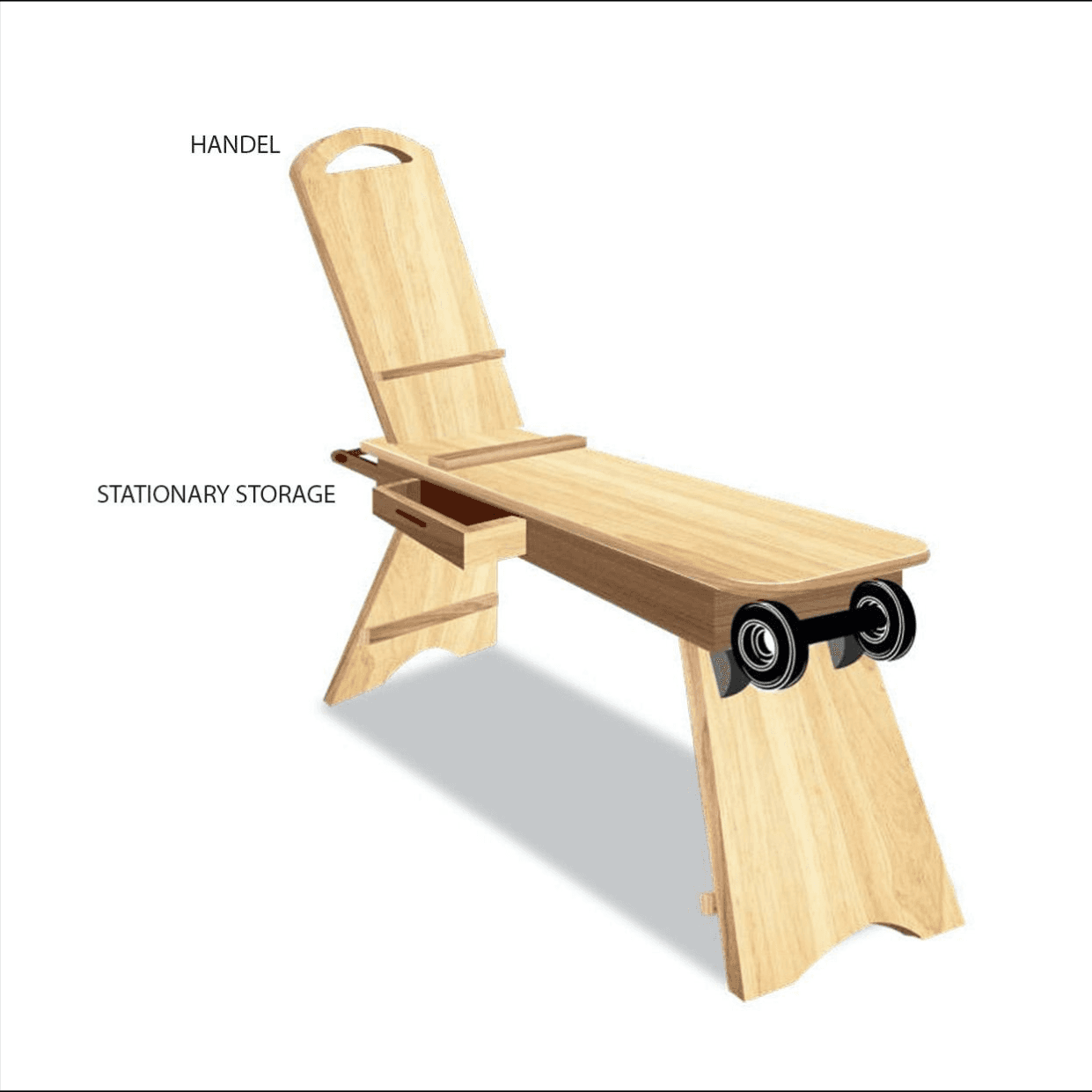


The sketching phase explored how the four priorities could coexist in one object — particularly the tension between structural rigidity when in use and compact folding when carried.
FINAL DESIGN
An ergonomically designed sitting easel in lightweight pine wood. Foldable legs with angle adjustment, a drawing board that tilts across five positions, and an integrated front tray for stationary and tools. When folded, it's flat enough to sit alongside a portfolio in a standard bag.
What I'd do differently: I'd prototype the folding mechanism physically before finalising the design. The sketched geometry works on paper, but a physical model would reveal friction points and hinge placement more quickly than any amount of drawing.
OUTCOME & REFLECTION
The design resolves all four original problems — portability through the folding mechanism, ergonomics through angle adjustment, storage through the integrated tray, and aesthetics through the material choice. Pine wood is warm, honest, and visually at home in a creative studio in a way that painted metal never is.