02 →
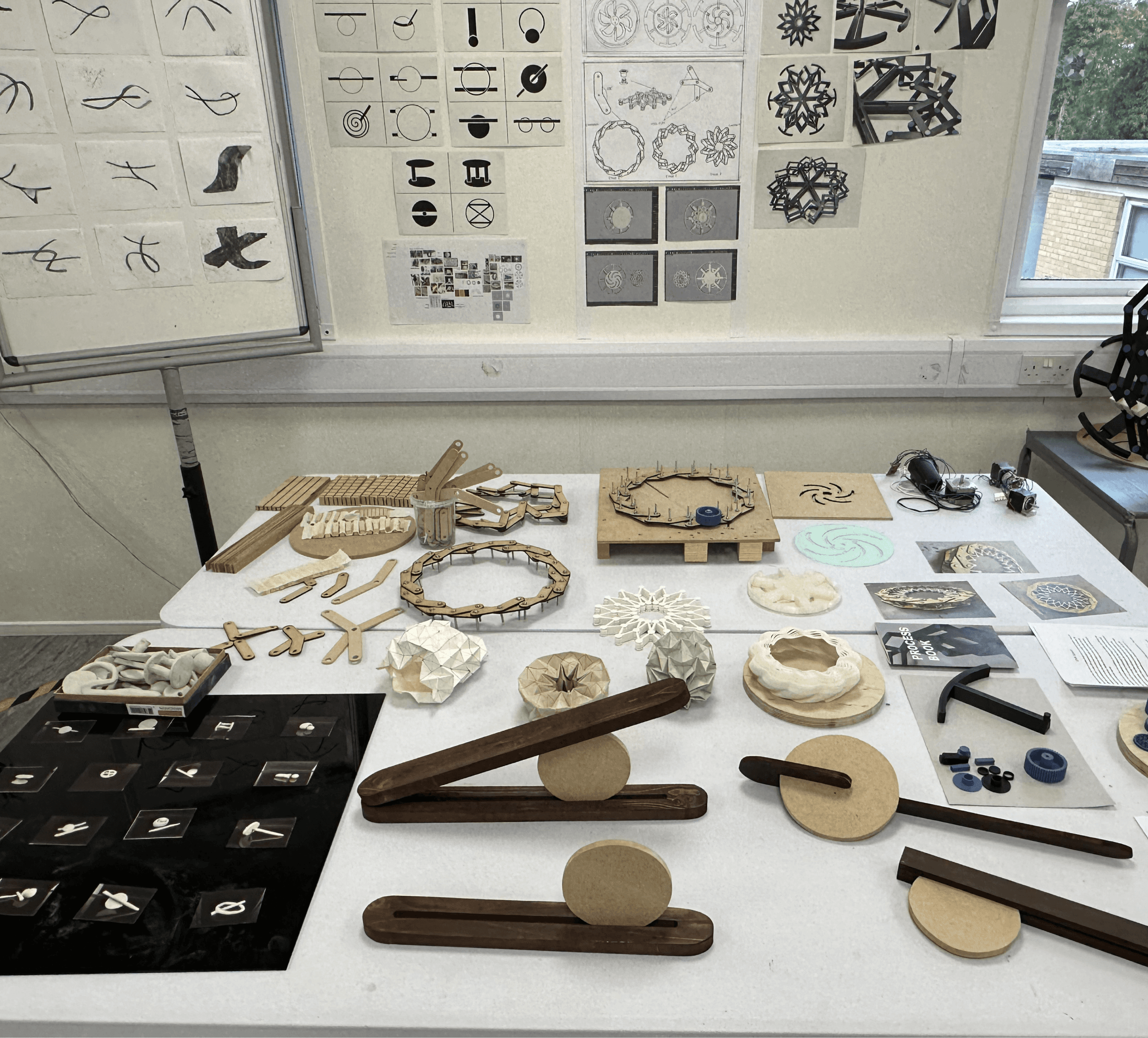
A complete record of the research, sketching, and iteration that shaped this project — 9 months condensed into one document.
DURING THIS PROJECT
3D printing
CNC laser cutting
Wood and metal work
Rapid prototyping
Technical drawing
Rhino
Photoshop · Illustrator
Pololu Tic stepper controller
Arduino
Miro
Mechanical engineering
Robotics
Transformation design
Physics
Material exploration
Physical skills
Software
Fields researched
DURING THIS PROJECT
A short demonstration film shows TransfoRim transforming in real time as it moves across changing terrain — sound on, full screen recommended.
DEMO


Provides grip on uneven, rocky terrain — the adjustable spikes expand and contract just enough to grip and drive the wheel forward. It adds sturdiness when stationary on smooth ground, and its geometry prevents gravel and debris from getting lodged in the wheel.
Structure 2 — smooth motion and structure
Provides smooth, uninterrupted movement on even terrain — the consecutive arcs forming a circle reduce friction and keep the wheel in motion. It sits between two layers of Structure 1, acting as the backbone and axis of the whole design, and houses the motors and controls for both structures at its centre.
Structure 1 — grip and protection
WHAT EACH STRUCTURE DOES
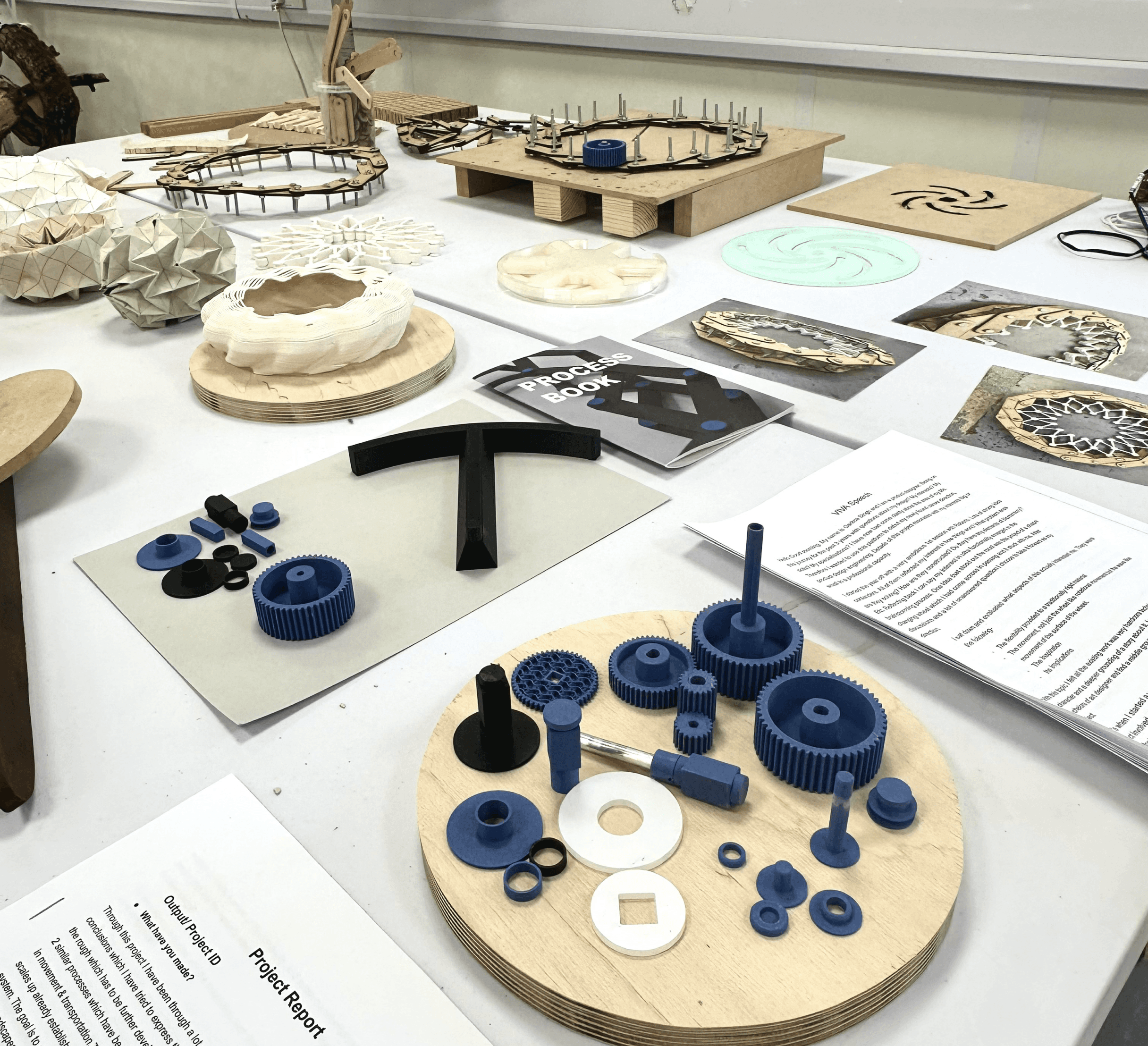
3D printed in carbon fibre, with every part segregated and printed individually for structural stability. Bearings reduce friction and smooth the movement.
A self-locking expanding structure documented in 507 Mechanical Movements (1868) — part of mechanical engineering's long-standing knowledge bank, originally used in safe and locker mechanisms.
Inspired by a bank lock mechanism
STRUCTURE 2


Built from laser-cut MDF arms bending at a 105° angle, 12 pairs hinged together with 3D-printed carbon-fibre joints — holding the structure exactly where needed while allowing smooth expansion and contraction.
An expanding, contracting structure patented by Chuck Hoberman, used across toys, architecture, and furniture. Its flexibility and sturdiness made it the right starting point for grip on uneven terrain.
Inspired by the Hoberman Sphere
STRUCTURE 1
THE MECHANISM — TWO STRUCTURES, TWO HISTORIES
After researching and prototyping extensively, the final mechanism combines two structures from completely different fields — one from a children's toy, one from 19th-century mechanical engineering.
Space exploration, where a single rover must handle unknown surfaces
Exploration of undiscovered or hard-to-reach terrain on Earth
Military vehicles operating across unpredictable ground conditions
Wheelchair accessibility across mixed indoor and outdoor terrain
A terrain-adaptive wheel isn't just a thought experiment — there are real contexts where this problem matters today:
APPLICATIONS
THE BRIEF
The wheel is one of the first products ever designed — which is exactly what drew me to it. It has gone through countless material and manufacturing updates over thousands of years, but the core concept has stayed constant, making it a rare example of a design that has stayed both classic and successful.
That raised an obvious question: what's next for wheels? I spent 9 months on it. The starting point was identifying three real problems — wheels are restricted to a narrow range of terrain, building a specialised wheel for every surface is costly, and there's no fast way to adapt a wheel when the terrain changes mid-journey.

ROLE
Solo designer, researcher, fabricator
DURATION
9 months, Goldsmiths
OUTCOME
Working prototype, exhibited
MATERIALS
Wood, Carbon fibre, 3D print,Metal,
Arduino
MIXED · ROBOTICS — PROJECT 01
TransfoRim
A real-time, terrain-adaptive wheel that transforms its shape depending on the surface it travels on
Graduate project · 9 months · Goldsmiths, 2025